How to Know When You Can Use Triple Integral
Example ane
A cube has sides of length iv. Let one corner be at the origin and the adjacent corners be on the positive $x$, $y$, and $z$ axes.
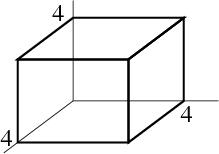
If the cube'due south density is proportional to the distance from the xy-plane, find its mass.
Solution: The density of the cube is $f(10,y,z) = kz$ for some abiding $thou$.
If $\dlv$ is the cube, the mass is the triple integral \brainstorm{align*} \iiint_\dlv kz\,dV &= \int_0^four \int_0^4 \int_0^4 kz\,dx\,dy\,dz\\ &= \int_0^4 \int_0^four \left(\left.kxz \right|_{x=0}^{10=iv}\correct) dy\,dz\\ &= \int_0^4 \int_0^4 4 yard z \,dy\,dz\\ &= \int_0^4 \left(\left. 4kzy \right|_{y=0}^{y=four}\right) dz\\ &= \int_0^four 16 kz dz = \left.\left.8kz^two\right|_{z=0}^{z=four}\correct. = 128k \finish{align*}
If altitude is in cm and $k=1$ gram per cubic cm per cm, then the mass of the cube is 128 grams.
Case two
Evaluate the integral \begin{marshal*} \int_0^1 \int_0^x \int_0^{one+10+y} f(x,y,z) dz \, dy\, dx \end{marshal*} where $f(x,y,z)=one$.
Solution: \brainstorm{align*} &\int_0^one \int_0^ten \int_0^{1+x+y} dz \, dy\, dx\\ &\qquad= \int_0^1 \int_0^x \left(z\Large|_{z=0}^{z=1+ten+y}\right)dy\, dx\\ &\qquad= \int_0^1 \int_0^x (i+x+y) dy\, dx\\ &\qquad= \int_0^ane \biggl[y + yx + \frac{y^2}{two}\biggr]_{y=0}^{y=x} dx\\ &\qquad= \int_0^1 \biggl(x + 10^2 + \frac{ten^2}{2}\biggr) dx\\ &\qquad= \int_0^one \biggl(x + \frac{3x^two}{2} \biggr) dx\\ &\qquad= \biggl[\frac{x^2}{2} + \frac{x^3}{2} \biggr]_0^i = \frac{i}{2} + \frac{one}{two} = 1 \end{align*}
Note: when we integrate $f(x,y,z)=one$, the integral $\iiint_\dlv dV$ is the book of the solid $\dlv$.
Instance 3a
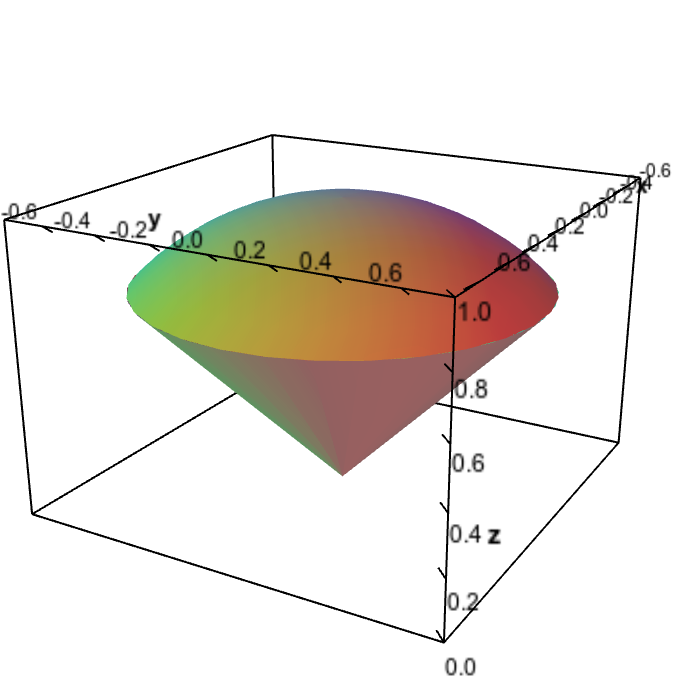
Ready the integral of $f(x,y,z)$ over $\dlv$, the solid "water ice cream cone" bounded by the cone $z=\sqrt{10^2+y^two}$ and the half-sphere $z = \sqrt{1-10^2-y^2}$, pictured below.
Applet loading
Ice cream cone region. The ice cream cone region is bounded above past the half-sphere $z=\sqrt{1-ten^2-y^2}$ and bounded beneath by the cone $z=\sqrt{x^two+y^two}$.
More information about applet.
Solution: We'll use the shadow method to ready upwards the premises on the integral. This means we'll write the triple integral every bit a double integral on the outside and a single integral on the inside of the form \begin{gather*} \iint_{\textit{shadow}} \int_{\textit{bottom}}^{\textit{superlative}} f(x,y,z). \finish{get together*} We'll let the $z$-axis exist the vertical axis and then that the cone $z=\sqrt{x^2+y^2}$ is the lesser and the half-sphere $z = \sqrt{1-x^two-y^two}$ is the top of the ice foam cone $\dlv$. Hence, $\dlv$ is the region betwixt these ii surfaces: \begin{align} \sqrt{x^two+y^2} \le z \le \sqrt{1-x^2-y^2}. \label{zinequalities} \end{align} These inequalities give the range of $z$ as a function of $10$ and $y$ and thus course the bounds of the inner integral, which will be an integral with respect to $z$ of the form \brainstorm{gather*} \int_{\textit{bottom}}^{\textit{top}} f(x,y,z)dz= \int_{\sqrt{ten^two+y^ii}}^{\sqrt{1-10^2-y^2}} f(x,y,z)dz. \end{gather*}
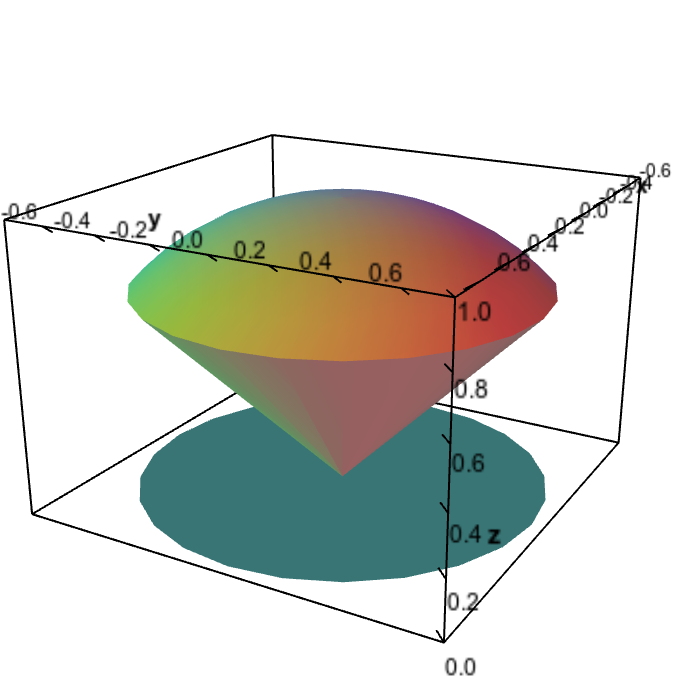
The whole region $\dlv$ is the set of points satisfying the inequalities \eqref{zinequalities} while $x$ and $y$ range over the shadow of the ice cream cone that is parallel to the $xy$-plane, every bit illustrated by the cyan circle below.
Applet loading
Ice foam cone region with shadow. The ice cream cone region is bounded above by the half-sphere $z=\sqrt{1-ten^2-y^2}$ and bounded below by the cone $z=\sqrt{x^ii+y^2}$. The two surfaces intersect along a circle divers by $x^2+y^2=ane/ii$ and $z=1/\sqrt{two}$, which is the widest part of the ice cream cone. Therefore, the shadow of the ice cream cone region parallel to the $xy$-plane is the disk of radius $1/\sqrt{2}$ described by $x^2+y^ii \le 1/two$.
More information virtually applet.
The shadow parallel to the $xy$-plane is the maximal range of $x$ and $y$ over all points inside $\dlv$. Within the ice cream cone, the maximal range of $x$ and $y$ occurs where the two surfaces meet, i.east., where the "ice foam" (the half-sphere) meets the cone. From the figure, yous can come across that the surfaces meet in a circle, and the range of $ten$ and $y$ is the disk that is the interior of that circle.
The surfaces meet when $ \sqrt{ten^ii+y^two} = \sqrt{1-x^2-y^2}$, which ways $ten^2+y^2 = one-x^ii-y^2$ or \begin{marshal*} x^2+y^2 = \frac{1}{two}. \end{marshal*} In other words, for any point $(x,y,z)$ in the ice cream cone, the inequality \begin{align} x^2+y^2 \le \frac{1}{2} \label{shadow} \stop{align} is satisfied. This inequality describes the shadow of the ice cream cone, which is the set of points $(x,y)$ that lie in a disk of radius $1/\sqrt{two}$, as illustrated below.
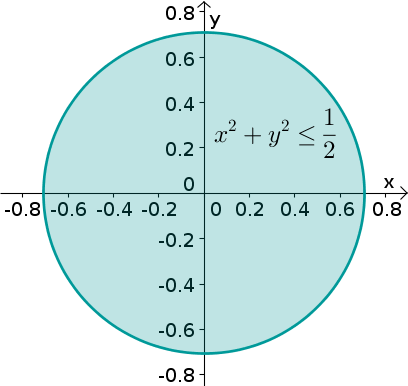
Now we've reduced the residue of the task of finding bounds for the triple integral to the much simpler task of finding bounds for a double integral over the shadow described by inequality \eqref{shadow}. We'll let $y$ be the inner integral of the double integral, meaning we need to depict the range of $y$ in the shadow as a function of $x$. To practice this, we simply rewrite inequality \eqref{shadow} in terms of $y$ equally \begin{align*} -\sqrt{1/2 - ten^2} \le y \le \sqrt{1/2 - x^2}. \end{align*} This range of $y$ as a function of $x$ gives the bounds on the inner integral of the double integral.
Finally, for the bounds on the outer integral, we demand the maximal range of $x$ lonely. Given that $x^2+y^2 \le 1/two$, the maximal range occurs when $y=0$ then that $x^2 \le 1/2$. Nosotros can write the maximal range of $x$ is \begin{marshal*} -1/\sqrt{2} \le ten \le 1/\sqrt{2}. \finish{align*} The double integral with respect to $x$ and $y$ becomes \begin{gather*} \iint_{\textit{shadow}} \cdots dy\,dx = \int_{-1/\sqrt{ii}}^{i/\sqrt{ii}} \int_{-\sqrt{ane/two-x^2}}^{\sqrt{i/ii-x^2}} \cdots dy\,dx \terminate{gather*}
We have determined all the limits on the iterated integral. Putting the bottom/meridian limits together with the shadow limits, the ice cream cone can be described by the inequalities \begin{get together*} -1/\sqrt{two} \le 10 \le 1/\sqrt{2}\\ -\sqrt{i/2 - ten^ii} \le y \le \sqrt{one/2 - x^ii}\\ \sqrt{x^ii+y^2} \le z \le \sqrt{1-x^2-y^2} \end{gather*} and the integral of the function $f(x,y,z)$ over $\dlv$ is \begin{align} \iiint_\dlv f\, dV = \int_{-1/\sqrt{2}}^{i/\sqrt{two}} \int_{-\sqrt{1/2-x^ii}}^{\sqrt{1/ii-x^ii}} \int_{\sqrt{ten^ii+y^2}}^{\sqrt{1-x^2-y^2}} f(x,y,z) dz\,dy\,dx. \label{icecreamintegral} \end{align}
Example 3b
Find the book of the ice cream cone of Example 3a..
Solution: Merely set $f(x,y,z)=1$ in equation \eqref{icecreamintegral}.
The volume of the ice cream cone $\dlv$ given by the integral \brainstorm{align*} \iiint_\dlv dV = \int_{-1/\sqrt{2}}^{1/\sqrt{2}} \int_{-\sqrt{1/2-x^2}}^{\sqrt{1/ii-x^2}} \int_{\sqrt{x^2+y^2}}^{\sqrt{1-ten^2-y^2}} dz\,dy\,dx. \terminate{align*} We won't attempt to evaluate this integral in rectangular coordinates. Once you've learned how to change variables in triple integrals, yous can read how to compute the integral using spherical coordinates.
Example 4
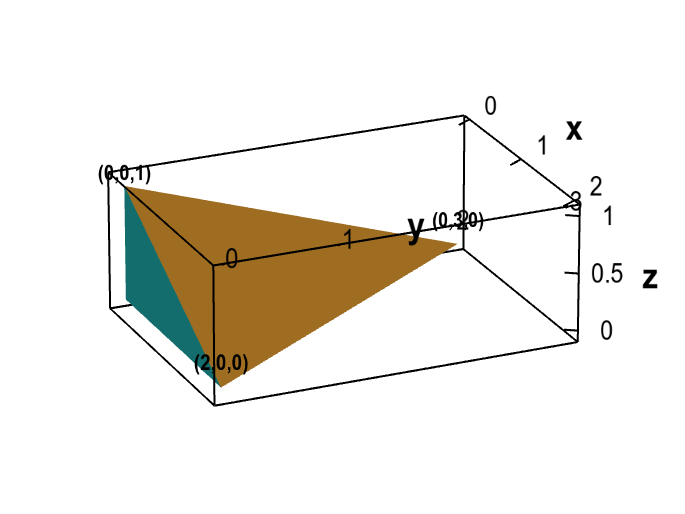
Find volume of the tetrahedron bounded by the coordinate planes and the aeroplane through $(2,0,0)$, $(0,3,0)$, and $(0,0,1)$.
Applet loading
A tetrahedron. The tetrahedron is bounded by the coordinate planes ($ten=0$, $y=0$, and $z=0$) and the airplane through the 3 points (2,0,0), (0,iii,0), and (0,0,1).
More than information most applet.
Solution: We know the equation for three of the surfaces of the tetrahedron, as they are the equations for the coordinates planes: $x=0$, $y=0$, and $z=0$. As an initial footstep, we can find the equation for the angled aeroplane. You tin can follow the procedure in the 2d forming aeroplane case to calculate that the plane is given past the equation \begin{align} 3x + 2y + 6z = 6. \label{plane_equation} \cease{marshal}
To find the limits of the tetrahedron, nosotros'll use the shadow method once again, but this fourth dimension, we'll think of the $y$-axis every bit existence the vertical axis. Y'all can imagine the sun that is casting the shadow equally beingness at some point far on the positive $y$-centrality.
With this orientation, the shadow of the tetrahedron is the maximal range of $10$ and $z$ over the tetrahedron. Since the tetrahedron gets wider in the $10$ and $z$ directions as $y$ decreases, the shadow of the tetrahedron is exactly the base of operations of the tetrahedron in the $xz$-plane (the aeroplane $y=0$), which is the triangle pictured below.
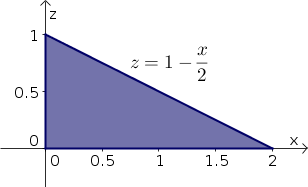
We approach the integral over this shadow as a double integral. In this shadow (and consequently in the tetrahedron itself), the total range of $z$ is \brainstorm{align*} 0 \le z \le 1. \end{align*} To find the range of $ten$ for each value of $z$, you can calculate from the figure of the shadow that the upper limit of $10$ is the line $z=one-ten/two$ or $x=2(one-z)$. Given that the lower limit on $x$ is zilch, the range of $x$ in the shadow for a given $z$ is \brainstorm{marshal*} 0 \le 10 \le two(1 - z). \stop{align*} Alternatively, yous could see that the upper limit on $ten$ corresponds to the plane given past equation \eqref{plane_equation} when $y=0$. Plugging $y=0$ into equation \eqref{plane_equation} yields $3x + 6z=6$ or $x = two(i-z)$.
For each value of $x$ and $z$ in the shadow, we demand to integrate $y$ from the bottom to the top (viewing $y$ as the vertical axis). The bottom from this perspective is in the plane $y=0$, and the meridian is the angled plane of equation \eqref{plane_equation}, which nosotros can solve for $y$ to write equally $y=iii(one-x/2 -z)$. Hence, for a given $z$ and $ten$, the range of $y$ is \begin{align*} 0 \le y \le 3\left(1 - \frac{10}{2} - z\right). \end{marshal*}
To detect the volume, we integrate the function one over this region: \begin{marshal*} &\int_0^i \int_0^{ii(1-z)} \int_0^{3(i- x/2 - z)} dy \, dx \, dz\\ &\qquad = \int_0^ane \int_0^{2(1-z)} 3\left(ane - \frac{x}{2} - z \right) dx \, dz\\ &\qquad = \int_0^1 three\left.\left[x - \frac{10^2}{4} -zx\right]_{x=0}^{x=2(1-z)}\right. dz\\ &\qquad = \int_0^1 3\left(two(ane-z) - (ane-z)^2 - 2z(1-z)\right) dz\\ &\qquad = \int_0^one 3(ane - 2z +z^two) dz\\ &\qquad = 3 \left.\left[ z - z^two + \frac{z^3}{3} \right]_0^ane\right.\\ &\qquad = 3\left(1 - ane +\frac{1}{iii}\right) = 3\left(\frac{1}{iii}\correct) = 1. \terminate{align*}
Example five
Change the order of $x$ and $y$ in the integral we derived above, \begin{align*} \int_0^1 \int_0^{two(1-z)} \int_0^{3(ane- 10/two - z)} dy \, dx \, dz, \end{align*} so that the guild will be $dx \, dy \, dz$.
Solution: Ane way to change the order of integration is to build upwards the graph of the tetrahedron from the limits of the integral, and so echo the procedure of Example four merely let the shadow be cast from the positive $x$-axis. Instead, we'll illustrate an alternative process of calculating the new limits directly from the inequalities of the old limits.
If $y$ volition be centre integral, we demand limits of $y$ in terms of $z$ (independent of $x$).
For given $z$, how large tin can $y$ range? From the above limits, nosotros know \brainstorm{align*} 0 \le y \le three\left(i - \frac{x}{two} - z\right). \cease{marshal*} The range is largest when $10=0$, then \brainstorm{align*} 0 \le y \le 3\left(1 - z\correct) \end{align*}
And then, given $z$ and $y$, nosotros need to know the range of the $x$. The post-obit relationship must however be true: \brainstorm{align*} y \le three\left(1 - \frac{x}{two} - z\right). \end{align*} We can rewrite this human relationship in terms of $x$ as \begin{align*} \frac{3x}{2} \le 3 - 3z -y, \stop{align*} or \begin{align*} ten \le 2\left(1 - z - \frac{y}{three}\right). \end{align*}
Since we as well know $x \ge 0$, the new limits of integration are \begin{align*} \int_0^i\int_0^{iii(ane-z)} \int_0^{two(1-z-y/3)} dx\, dy \, dz. \terminate{align*}
More examples
More than examples of calculating triple integrals can be plant in the pages describing the shadow method and cross section method of determining integration premises.
How to Know When You Can Use Triple Integral
Source: https://mathinsight.org/triple_integral_examples
0 Response to "How to Know When You Can Use Triple Integral"
Post a Comment